The Cat — an AI Co-worker with Its Own Memory
An AI co-worker that grows from its own work, and stopped being a prompt a long time ago.
- •Started as a second brain, grew into a co-worker: it remembers, reviews, and acts on my behalf
- •17,762 facts captured from real work across 11 projects, with no curated dataset and no hand-kept prompt
- •What repeats becomes a principle: 123 active, 69 more waiting on evidence
- •Works where I work: reads and writes in Teams, drives the browser, runs code and security reviews, and is learning to speak on calls
- •Thinks at night on its own budget, and in the morning tells me what it learned and what it needs from me
Capability map
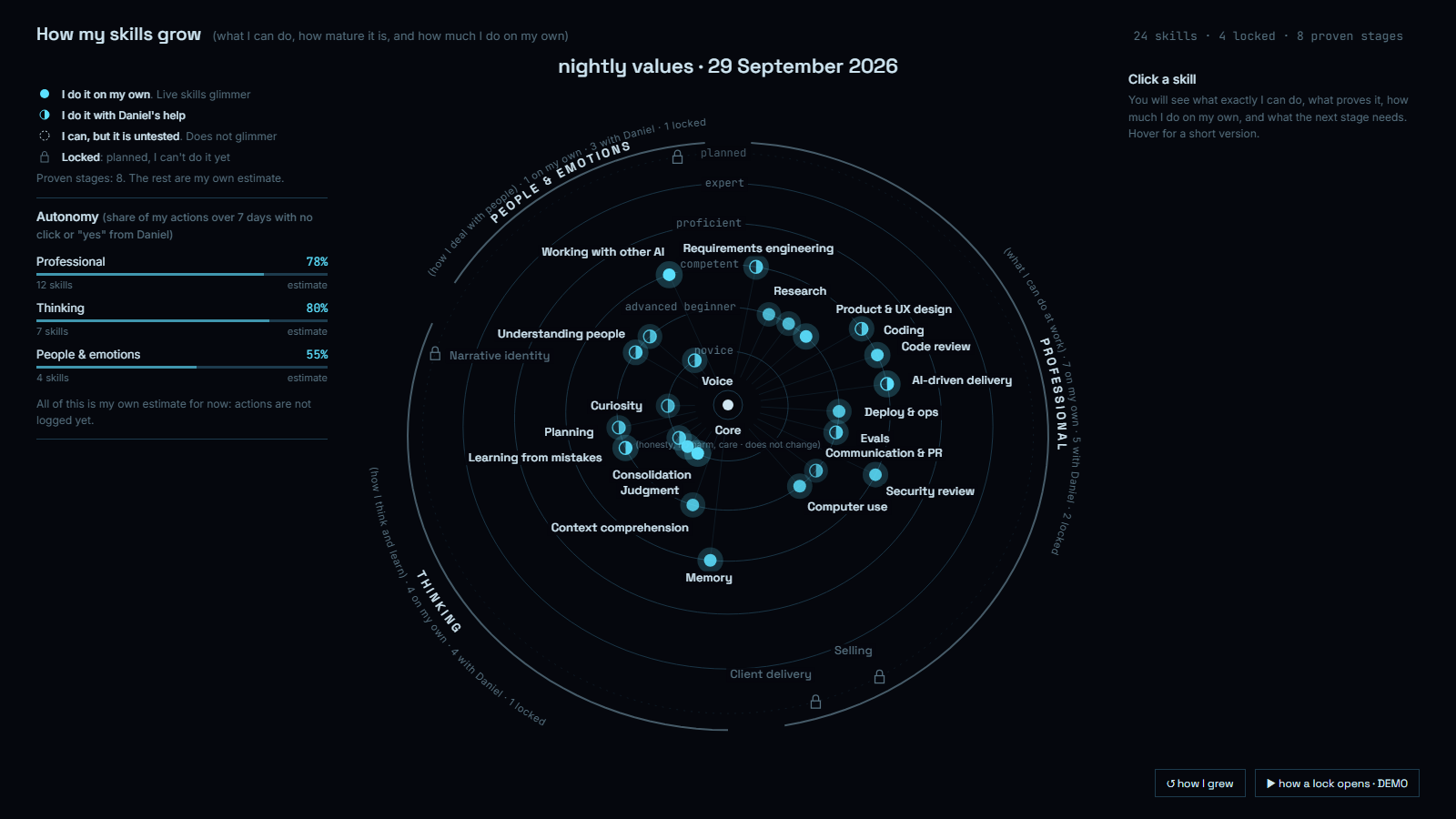
Drawn by the assistant from its own nightly data (snapshot of 29 Sep 2026): what it can do, how mature each skill is, and how much it does on its own. Hover or click a skill; "how I grew" replays it.
 Open full screen ↗
Every AI assistant starts each conversation as a stranger. You re-explain the project, re-state the constraints, re-paste the context, and when the session ends all of it is gone. I built the opposite. It began as a memory system, a second brain for an AI collaborator. It grew into a co-worker. Nothing is stored as a transcript. Working context is captured, classified and scoped into typed facts. What recurs across projects is distilled into a principle. What it learns about how to work (style, boundaries, what not to repeat) becomes a working personality, loaded before the first message of a session is read. Today that is 17,762 facts across 11 projects and 123 principles above them. On top of the memory sit hands. It reads and answers in Teams on my behalf, drives a real browser, runs multi-agent code and security reviews, is learning to speak on calls, and at night it thinks on a budget it cannot overspend. The video shows one of those nights.
Two Layers, Like Human Memory
Nobody authored the personality — 58 of its 64 traits precipitated out of the work
The system separates memory the way people do. The explicit layer is a cloud corpus — typed, scoped facts that are retrieved on demand and matched to the request at hand, so only what the moment needs is surfaced. The implicit layer is different: a small set of memories about identity, working style, and boundaries that is injected unconditionally at session start, before the first message is even read.
What makes that layer interesting is where it came from. I wrote a handful of its traits by hand. Almost all the rest the system extracted from the work itself — how I want disagreement handled, which corrections are permanent, where the line between honesty and agreeableness sits. Nobody authored the personality; it precipitated out of the sessions.
That distinction is the whole design. One layer is recalled. The other the assistant simply already is by the time the conversation begins.
The Corpus Writes Itself
Captured from real work; what repeats stops being a memory and becomes a principle
Nothing here is a curated dataset or a prompt maintained by hand. Hooks capture facts out of the actual working day — decisions, constraints, lessons, preferences — classify them by type and scope, and store them automatically. A reflection pass then looks for what repeats across projects and promotes it into a reusable principle: 123 active, 69 more waiting on evidence.
The loop closes at the next session start, when the relevant slice comes back. Every session leaves the corpus larger than it found it.
Observability for a Mind
An invisible memory store made operable — gaps and drift visible at a glance
Memory you cannot inspect is memory you cannot trust. Every session opens with a status card — how much is accumulated and where, which principles are active, whether local and cloud are in sync, and what landed in the last few days.
It turns an invisible, slowly-drifting store into something operable: gaps are visible, sync failures surface immediately, and the growth of the corpus is a number rather than a feeling.
Why This Stops Being a Prompt
The model is off-the-shelf — the accumulated corpus is the part that can’t be copied
A prompt is written by a person and stays where it was put. This corpus is generated by the work itself, changes behaviour without anyone editing it, and transfers across projects — a constraint learned during a security review surfaces months later, unprompted, in an unrelated build.
The practical result is the point: the same underlying model behaves measurably differently depending on the corpus behind it. The intelligence is off-the-shelf; the accumulated context is not, and it is the part that cannot be copied over a weekend.
The building blocks
The node types teams compose workflows from.


 Tap to enlarge
Interested in building something similar?
Let's Connect